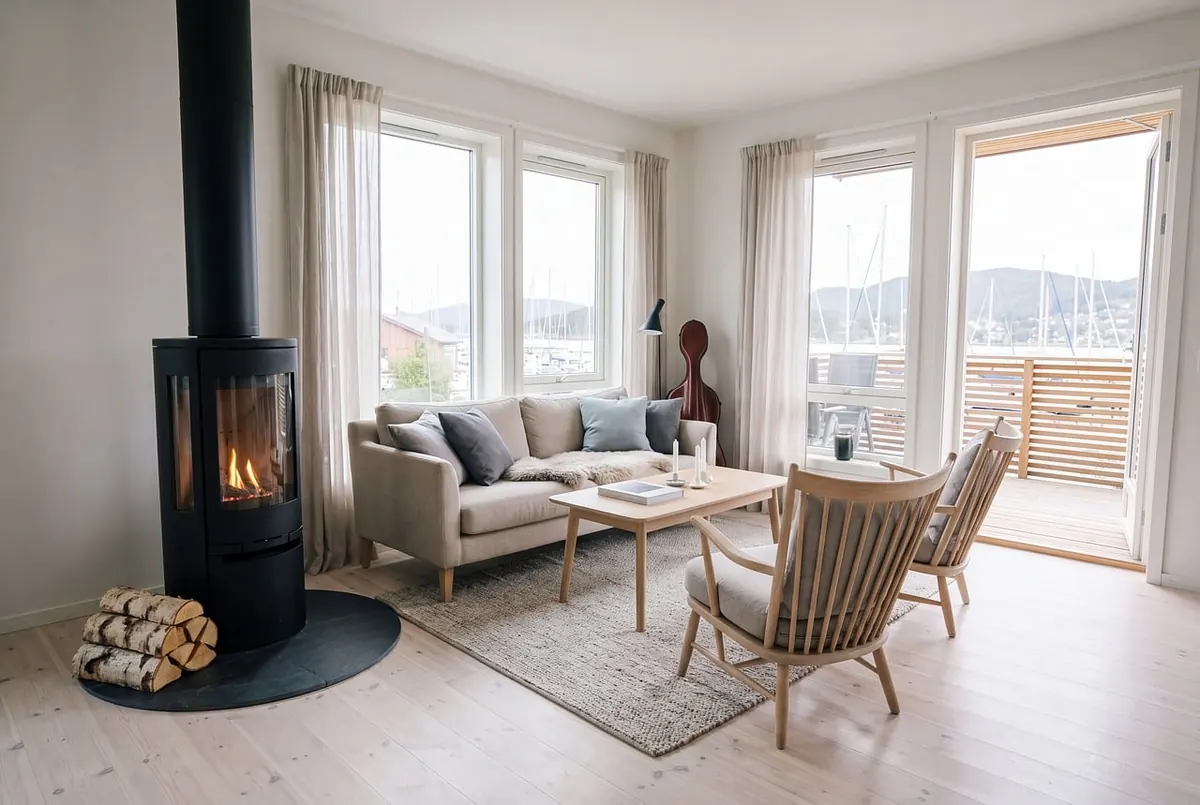
A wood stove is one of the few home improvements that pays you back every evening: warmth, a focal point, and a reason to stay put rather than retreat to the sofa in another room. The difference between a stove that lights easily, burns cleanly and heats the space, and one that smokes back, soots its glass and swallows logs, is almost always the installation rather than the appliance itself. These are the mistakes that come up again and again, and how to sidestep them before the delivery van arrives.
Every stove comes with minimum clearances: the distances from the top, sides and back of the appliance to any combustible surface. Those figures come from the manufacturer, and they take precedence over the general figures in the building regulations. The surfaces people forget are the ones that cause trouble — timber skirting behind the stove, a wooden mantel above it, a television mounted on the chimney breast, curtains that billow when a door opens.
Heat shields can reduce clearances, but only in the specific ways set out in the manufacturer's instructions or the relevant guidance. Don't improvise with a sheet of steel and hope for the best. The flue counts too: where it passes through a ceiling or a loft, it must keep its own clearance from timber unless it is a twin-wall insulated section designed for the purpose.
A flue works on draught — warm gases rising and pulling fresh air into the stove behind them. Every bend and horizontal run slows that process. Keep the run as vertical as you can; if you must offset, gentle 45-degree bends work better than 90-degree elbows, and two is usually the sensible limit. A flue that exits the back of the stove, crosses a wall and climbs the outside of the house will struggle, particularly in mild, still weather.
Older masonry flues leak, and clay liners crack. Most installations in an existing chimney involve a stainless steel liner, and it should be insulated — wrapped or backfilled with vermiculite. An uninsulated liner inside a cold external chimney cools the flue gases, which leads to condensation, tar deposits and a weak draught. That is the mechanism behind a great many "my stove smokes when I open the door" complaints.
The top of the flue needs to clear the roof and sit away from anything that could pull air out of it. Manufacturers usually specify a minimum overall flue height from the appliance to the terminal, and typical guidance places the terminal at least 600mm above the ridge line, well clear of opening roof windows, vents and neighbouring structures. Get this wrong and you will be fighting the stove for years.
The hearth is not decoration. It protects the floor from heat and from falling embers. A constructional hearth is part of the building — a solid, non-combustible slab, commonly required to be around 125mm thick — and it must extend beyond the appliance at the front, sides and rear by a set margin. A decorative hearth, often a slate or stone slab roughly 12mm thick, can sit on top of a constructional hearth, but it does not replace one.
The appliance must sit entirely on the hearth rather than overhanging it, and the front margin matters most, because that is where a log can roll out. If the stove is going onto a timber floor, the floor beneath needs proper protection; heat travels downwards as well as sideways. Building control will want to see this detail, and an installation that doesn't comply becomes a problem at the point of sale. Confirm the exact figures for your situation with your installer or local building control, as they vary with the appliance and the property.
A stove needs air, and in a sealed modern house with extractor fans running, it cannot always find it. A permanent, purpose-made air vent is often required, sized according to the appliance's rated output — a commonly cited figure is around 550mm² of free air per kilowatt above 5kW, but check the manufacturer's instructions and your local building control. A trickle vent in a window is not a substitute.
Where you put the vent matters. Behind or beside the stove is often best, so cold air does not wash across the room. Never block it, and don't let a sofa or bookcase end up in front of it. Then think about pressure: a powerful kitchen extractor or a bathroom fan can pull air down a flue that is already struggling, and that is when a stove starts spilling smoke indoors. A carbon monoxide alarm in the same room is essential regardless.
An oversized stove is the most common cause of disappointing performance. If the appliance is too big for the room, you end up running it with the air controls nearly shut, which produces a cool, smouldering fire, blackens the glass, lines the flue with tar and wastes logs. A smaller stove run properly gives cleaner burning and more usable heat.
Ask for a heat loss calculation for the actual room rather than a guess based on the size of the house. Think about how you will use it: a room you occupy every evening needs less than one you are trying to bring up to temperature from cold. If the space is well insulated and draught-proofed, err on the smaller side. Look for a stove with proper secondary and tertiary air so it can burn cleanly instead of acting as a hot box.
Photo: FernandoZ / Pixabay
Smoke control areas cover much of urban Britain. Here's how to check your postcode, which fuels are authorised, and...
Wet wood wastes heat and lines your flue with tar. Here's how to split, stack and test firewood so it burns hot,...
A practical guide to fire guards, log baskets, ash caddies, tools and hearth rugs — how to choose kit that keeps...

Your cozy guide to fireplaces and hearth living.
